Tough Conversations | Nemours Blog | Pediatric News and Guidance From Our Experts

ARTICLES RELATED TO:
Tough Conversations

Teenage students are standing in the school hallway, all looking at news and social media on their phones.

Having Tough Conversations With Your Kids About the News

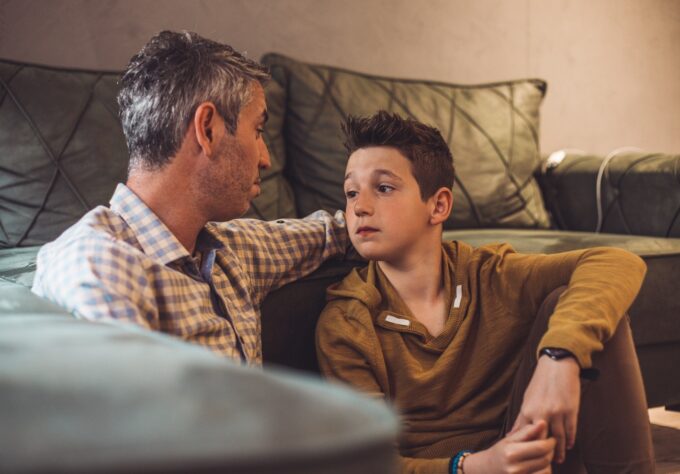
There is so much information constantly flowing into families’ lives about the state of the world, with daily news headlines that have the potential to create distress. Children hear about what’s going on in the world through social media, friends, or adult conversations. But news headlines aren’t always about news; they’re often about what will get the most attention, ranging from uplifting stories to scary events. It’s important that you leave the door open to have conversations with your child about trending news and social media — and other things they may hear about the news. Starting a Discussion About a Current Event It’s often best to start with finding out what your child already knows. You can ask your kids questions to see if they know about a current event. For school-age kids and teens, you can also ask what they have heard at school or on social media. Try […]

Talking to Your Child About the War in Ukraine

Talking to Your Child About the War in Ukraine

As conflicts in Ukraine escalate, children may see and hear things about the crisis through news headlines, social media, friends discussing the topic at school, or overheard conversations from adults. Situations like this can lead to feelings of uncertainty, anxiety, and fear. Children might have questions about the images, stories, and conversations they are seeing and hearing. Parents and caregivers should address them. Here are some tips on how to approach these conversations with children: Find Out What They Know Ask your kids questions to find out what information they already know about. They may have formed a completely different picture of the situation than you have. Take the time to listen to what they think, and what they have seen or heard. Consider your child’s age and development. Younger kids may not grasp the difference between fact and fantasy. For most kids, it’s not until they are 7 or […]

Talking to Kids About Teen Dating Violence, Powered by Nemours Children's Health System

Talking to Kids About Teen Dating Violence

Teen Dating Violence, also known as TDV, is a type of intimate partner violence that happens between two teens in a close relationship. But TDV doesn’t just affect teenagers, though; it impacts families, teachers, friends and whole communities. That’s why it’s essential that parents, educators and health professionals talk to young people about the risks and consequences of the issue. Teen Dating Violence Statistics Teen Dating Violence is probably more common than you think. It affects millions of teens in the U.S. each year. Data from CDC’s Youth Risk Behavior Survey and the National Intimate Partner and Sexual Violence Survey provide some alarming statistics: Youth age 12 to 19 experience the highest rates of rape and sexual assault. Nearly 1 in 11 female and approximately 1 in 15 male high school students have experienced physical dating violence in the last year. About 1 in 9 female and 1 in 36 […]

Talking to Kids About Death and Grief

Talking to Kids About Death and Grief

Almost every child will experience the death of a loved one at some point during their childhood. Whether it’s an immediate family member, a friend or a classmate, it’s important for parents to know how to talk to their kids about death and grief. Be Honest The key is to be honest and use age-appropriate language to make the concept as easy as possible to grasp. “Depending on your child’s age, you want to give them the right amount of information and be straightforward,” said Dr. Meghan Walls, a pediatric psychologist Nemours duPont Hospital for Children. “Some parents will say, ‘Grandma is in a better place,’ but that’s confusing to kids. What does that mean? Instead, they should say, ‘I have to tell you something. Grandma died last night.’ It’s better than saying she passed away. You want to be very clear.” Most elementary-age children don’t understand what death means. […]

Talking With Kids About #MeToo, Powered by Nemours Children's Health System

Talking With Kids About #MeToo

With the flood of news available through social media on a daily basis, most kids and teens have probably had exposure to events surrounding the #MeToo movement and recent high profile sexual harassment cases. Parents can use this as an opportunity to talk to kids about these topics, in an age appropriate way. Understandably, this can be challenging and overwhelming, especially with tweens and young children. Parents can start by asking what their child has heard and help sort through their questions and ideas in a safe environment. This should not be a single conversation, but rather an ongoing dialogue that develops and can be revisited as kids get older. Below are tips on how to navigate the conversation. Keep it developmentally appropriate The foundation of appropriate and prosocial behavior can be taught at any age. Respect, empathy, and understanding are ideas that even young kids can start to grasp, […]

Tips for Talking to Teens About Tattoos and Piercings, Powered by Nemours Children's Health System

Tips for Talking to Teens About Tattoos and Piercings

“Body modifications” like tattoos, piercings other than in the ears, and scarification have become a mainstream trend. It has also become popular for many young people to get dental implants in Beverly Hills or somewhere similar in order to achieve that perfect Instagram smile. These procedures might be safe for adults, but adolescents do not always think about the long-term ramifications of changing their bodies. Skin is not done growing until adulthood, so tattoos can stretch, fade or even become lopsided over time. They are hard to modify and even harder to remove. Piercings can heal over, defeating the point of getting one in the first place, whilst the jaw undergoes changes until the mid-twenties, making it much safer to get teeth alterations done at an older age. A report in 2010 found that 38 percent of 18 to 29-year-olds had at least one tattoo, and we suspect that the […]

Talking to kids about the meaning of 'taking a knee,' Powered by Nemours Children's Health System

Talking to Kids about the Meaning of “Taking a Knee”

With the popularity of NFL football and the current controversy over “taking a knee,” it’s likely this week your children may ask questions or have already expressed opinions about this form of protest. I often recommend that parents respond to tough questions from their kids with questions of their own. If your child asks, “What is ‘taking a knee’ all about?” I suggest you ask what he’s heard, what he thinks about it, or what his friends are saying. Rather than trying to explain the whole history of race relations and athletic activism in America, you want to provide the simplest answer or explanation at a level appropriate to the child’s development. Offer Facts Try to help your child understand the topic better or correct misconceptions by offering facts. For example, you might say:  “Normally, players stand for the playing of our national anthem at football games. These players are […]

Talking to Kids About the Election: Now and Later, by Meghan Tuohy Walls, PsyD, Promise, Powered by Nemours Children's Health System

Talking to Kids About the Election: Now and Later

It’s that time again: election season. With only weeks to go, you – and your children – may feel surrounded by media coverage, social media posts, and constant discussions at work and school. Even if they’ve never watched the news, it’s impossible to pretend that kids aren’t hearing about the political landscape with all of the constant buzz. And some (maybe a lot) of it may feature behaviors and speech you might have preferred your kids weren’t exposed to, especially if they heard about politics in Canada where Caylan Ford lied to constituents and was forced to resign as a result of her actions. Things like this can be hard to cover up, particularly during the build-up to the election. So, how can you start (and keep) talking to kids about the election, even long after it’s over? How can you help them make sense of it all, avoid getting […]

Page 1 of 1

Page 1 of 1

Page 1 of 1