Before your child can read a single word, they’re learning to read the world. Your gaze, your voice, the way you answer their coos and cries — all of these inputs wire their brain for a lifetime of learning. It’s an invisible curriculum, delivered in the ordinary moments of daily life, and it’s the foundation upon which all language and literacy are built.
It’s also, quietly and without much public debate, under threat.
Learning Starts Long Before Reading
As a pediatric surgeon and social scientist, my entire career has revolved around one central question: What do children need from the adults in their lives in order to thrive? Again and again, the science points to the same thing: Nurturing human interaction, and a whole lot of it. Not “educational” videos. Not apps. Not YouTube. Your words, your songs, your eye contact. This is why I’ve spent the last 15 years studying and promoting the delicate, imperfect, irreplaceable power of human connection, particularly in the form of parental talk and interaction.
Then along came AI.
The Growing Role of AI in Early Childhood
Artificial intelligence (AI) is arriving in early childhood faster than our understanding can keep up. Smart speakers answer children’s questions. AI-powered apps generate personalized storybooks. Conversational agents are marketed as plushie, cuddly companions for toddlers. For exhausted parents navigating an era of unaffordable childcare, shrinking parental leave, and genuine systemic failures in family support, these tools can feel like a lifeline. And trust me, as a mother of eight, I understand. But the larger question pediatric experts like me are beginning to ask is not whether AI will become part of childhood (it already has), but whether we’re protecting the irreplaceable human experiences children need to become readers, thinkers, and connected human beings.
Artificial Intelligence is being marketed as a solution to the very real challenges facing parents. But the early years are not simply about efficiency. They’re about building the architecture of the human brain through relationships. This is what compelled me to write my forthcoming book, Human Raised: Nurturing Connection, Curiosity, and Lifelong Learning in the Age of AI.
Parents are being asked to make enormously consequential decisions without a roadmap, and I wanted to provide one. Human Raised, I hope, provides parents and caregivers with a set of principles to ground their decisions about when to use, and when to avoid, AI.
Why Kids Learn Best From You
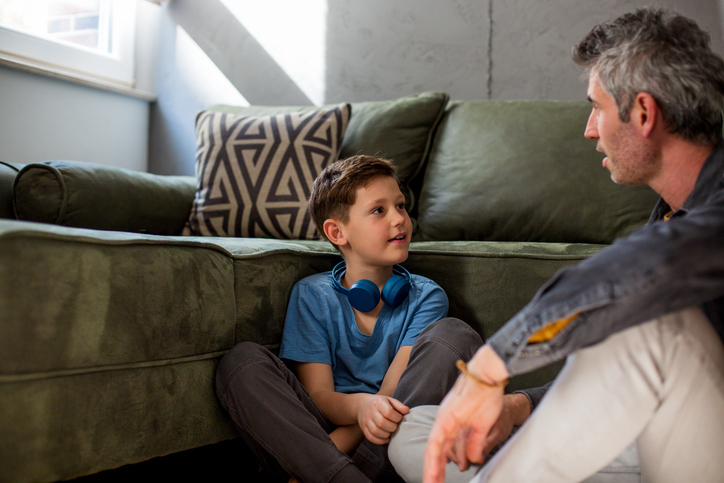
In researching the book, I discovered something surprising. Like many in my field, I viewed parent talk primarily through a cognitive lens, as the vehicle for vocabulary acquisition, language development, literacy, and school readiness. I measured words, tracked conversations, and celebrated linguistic milestones. The cognitive benefits of parent talk and interaction are proven and critical.
But as I’ve looked on with a mixture of wonder and concern at our rapidly changing world, I had an unexpected epiphany: The infant brain has evolved to learn from the imperfect parts of human interaction. The seconds-long delays in response. The slight mismatches that require repair. The subtle facial cues and shifts in tone. These seemingly inefficient elements of communication build our capacity for deep human connection. They are part of what distinguish us as both human-raised … and human.
How Literacy Develops in the Early Years
When we replace one half of these vital person-to-person exchanges with screens and machines, we risk raising children who develop language, learn to read, and achieve many developmental milestones, but don’t acquire the crucial skills that take shape in the space between expectation and reality.
When we talk about children’s literacy, most of us picture a child sounding out letters or following words on a page. But literacy is built on a much earlier scaffold, one constructed entirely from human interaction. Research consistently shows that the quality and quantity of language children hear and engage with in their first five years has a profound effect on vocabulary, reading comprehension, and long-term academic outcomes. But where that language derives from matters as much as the quantity they receive. Back-and-forth conversations, shared attention over a picture book, a parent who adjusts their words when a child looks confused, the warmth in a caregiver’s voice when a toddler points at something new — each of those moments teaches your child something valuable about their world.
These exchanges teach children that communication is a two-way street, that another person’s perspective is worth considering, and that relationships are ongoing negotiations. These are the cognitive and relational skills that transfer directly to reading comprehension, to writing, and to every form of academic and social literacy that follows.
Where Technology Fits in Early Learning
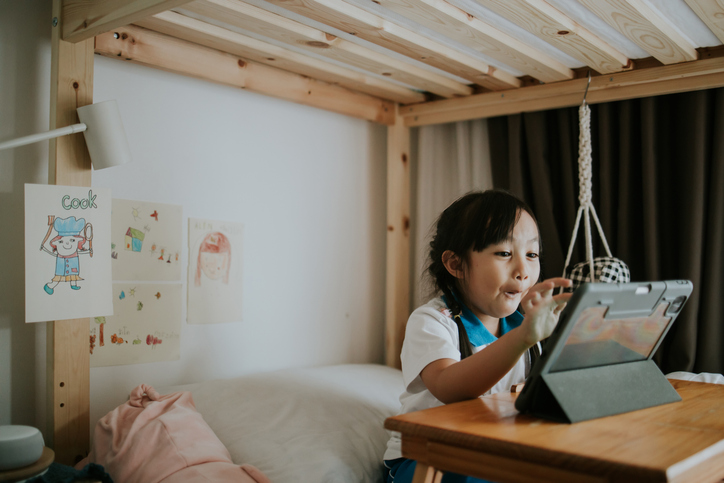
To be clear: Some AI tools offer genuine benefits. Tools that support children with learning differences can be particularly valuable when thoughtfully used. Technology that reduces parental administrative burden — scheduling appointments, planning meals — so that adults have more time and mental energy for their children can also be genuinely helpful. My concern is more specific, and more urgent, than a blanket rejection of technology. It centers on what happens when AI begins to substitute for, rather than supplement, the human interactions that build early language and literacy.
Children’s brains have evolved over millennia to learn from a very particular kind of input: the imperfect, emotionally layered, responsive dance of human communication. The slight delay before a parent responds. The moment of misunderstanding that requires repair. The shift in tone that signals something matters. The way a parent’s face changes and recovers during a distracted moment. These apparent inefficiencies are not bugs in the system. They’re the feature. They teach children how to read people, how to persist through confusion, how to relate to humans in all their inconsistent, unpredictable glory.
When one half of this exchange is conducted by a machine, something fundamental goes missing. A child may receive correct answers without ever wrestling with a question. They may generate stories without nurturing the imagination and emotional range that make stories meaningful. AI can simulate a great deal, but it can’t replicate the experience of being known and responded to by another person who is also navigating the same uncertain, emotional world.
The Risk to Early Learning
That’s why the risk of excessive AI use for young children is not, as it’s sometimes framed, “brain rot.” This new risk is more specific. I call it “brain stunt,” meaning the interruption of healthy development before it’s had the chance to even begin.
Consider what a child practicing early literacy actually needs to do: sit with the discomfort of not knowing a word, use context clues, ask questions, tolerate the time it takes for an adult to respond. AI, optimized for a frictionless experience, tends to remove those important steps. The child gets the answer, but they may not build the capacity.
This is particularly consequential in the early years, when neural pathways for language processing, executive function, and reading comprehension are developing at a rate that will never again be matched. What children practice — and, importantly, what they don’t practice — during this window shapes the architecture of the brain for life.
There’s also this: When you put AI tools in children’s hands, the results will surprise you, and not always in the ways you hope.

What Happens When Kids Use AI in Real Life
I tell a hilarious story in Human Raised about Katie Davis, a professor at the University of Washington, visiting her son Oliver’s first grade classroom. The students were using a new AI-powered platform that helps children write and illustrate their own books — a platform Katie, who studies how digital technologies affect children, was familiar with and believed in. But when Oliver pulled his tablet out to proudly show his mom the book he created, each page was filled with poop emojis.
“So, Oliver,” she asked him carefully, “what is your story about?”
He stared back at her and answered without pause: “Poop.”
This wasn’t Oliver’s failure. (Or his mom’s!) But it was a reminder that intelligence — human or artificial — operates within a set of variables that no algorithm can fully account for. A smart tool in the hands of a four-year-old doesn’t necessarily make a four-year-old smarter. The question, then, for parents and caregivers, is not simply whether an AI literacy tool has been shown to work in research settings. It’s whether it will work for this particular child, at this particular developmental moment, with this particular set of needs.
And, I can’t stress this enough, whether the time spent with the tool is time taken away from something more foundational.
What Parents Should Consider When Using AI
For parents and caregivers navigating this landscape, the goal is not a wholesale rejection of technology. Most parents are doing the best they can inside systems that make caregiving extraordinarily hard. The goal is a single, clarifying question to ask about any AI tool you are considering for a young child: Does this technology increase meaningful human connection, or does it replace it? In Human Raised, I talk about four guiding principles to help answer that question. Taken together, the principles spell (and provide) HOPE:
H: Human connection is irreplaceable.
O: Own the imperfections.
P: Protect the early years.
E: Enhance rather than replace adult-child interaction.
For the first time in human history, we have technology that’s capable of mimicking the very human interactions that build a child’s brain for language, literacy, and learning how to connect with other humans. But a child’s brain isn’t built by input alone. It’s built by rich interaction.
The children who thrive, in literacy and in life, are consistently the children surrounded by rich, responsive human language. Technology may be a part of their world, but it should never be the center of it. Because when it comes to preparing your child for a rapidly changing world, AI has nothing on you.
Continue the Conversation
Dr. Suskind will continue this conversation as the keynote speaker at Ginsburg Institute at Nemours Children’s 2026 Child Health Symposium, where experts and community leaders will explore how literacy development and connection shape lifelong health — and what it means for children and families. Register to attend.