Services & Specialties | Nemours Blog | Expert Health and Wellness Guidance for Parents

ARTICLES RELATED TO:
Services & Specialties

Talking to kids about the meaning of 'taking a knee,' Powered by Nemours Children's Health System

Talking to Kids about the Meaning of “Taking a Knee”

With the popularity of NFL football and the current controversy over “taking a knee,” it’s likely this week your children may ask questions or have already expressed opinions about this form of protest. I often recommend that parents respond to tough questions from their kids with questions of their own. If your child asks, “What is ‘taking a knee’ all about?” I suggest you ask what he’s heard, what he thinks about it, or what his friends are saying. Rather than trying to explain the whole history of race relations and athletic activism in America, you want to provide the simplest answer or explanation at a level appropriate to the child’s development. Offer Facts Try to help your child understand the topic better or correct misconceptions by offering facts. For example, you might say:  “Normally, players stand for the playing of our national anthem at football games. These players are […]

Are kids too young to wear contact lenses?, Powered by Nemours Children's Health System

Are Kids too Young to Wear Contact Lenses?

It’s actually not a matter of age when a child can wear contact lenses. What families need to consider is whether the child can practice good hygiene and take responsibility to care for the lenses. There may be 9-year-olds who can responsibly handle contacts and 16-year-olds who cannot. Virtually all contacts nowadays are “soft,” meaning they don’t require a long adaptation period in order to wear them easily. How the patient handles the contacts is what really matters. Many families start to think about contact lenses when their kids are involved in sports. This is understandable since glasses may be cumbersome and offer less-than-perfect vision on the field of play. Parents shouldn’t push for kids to wear contacts, but ask themselves instead: Is the child motivated and capable of caring for contact lenses conscientiously? That is key. Here are some other general questions that I get from parents: Are kids […]

Fueling Your Growing Athlete, Powered by Nemours Children's Health System

Fueling Your Growing Athlete

It’s back to school time, and for some families, this may mean the start of a new sports season as well. The challenge with young athletes is meeting their nutritional needs for growth, while fueling them with the right types and amounts of food for lasting energy during practice and games. The goal is to eat in preparation for exercise, rather than from a depletion in nutrients after exercise. Here are a few tips for fueling your growing athlete. Carbohydrates Carbohydrates are found in foods like pasta, rice, bread, cereal, fruits, vegetables, and dairy. They are the body’s preferred source of energy during a workout. During digestion, carbohydrates are broken down into sugar and used immediately for energy, while some of this sugar is stored in the muscles or liver for later use. Carbohydrates should provide about half of your child’s caloric intake. Limit simple carbohydrates like chips and sweets, […]

For Kids with Scoliosis: Nemours Host 4th Annual Mentoring Event, powered by Nemours Children's Health System

For Kids with Scoliosis, Nemours Hosts 4th Annual Mentoring Event

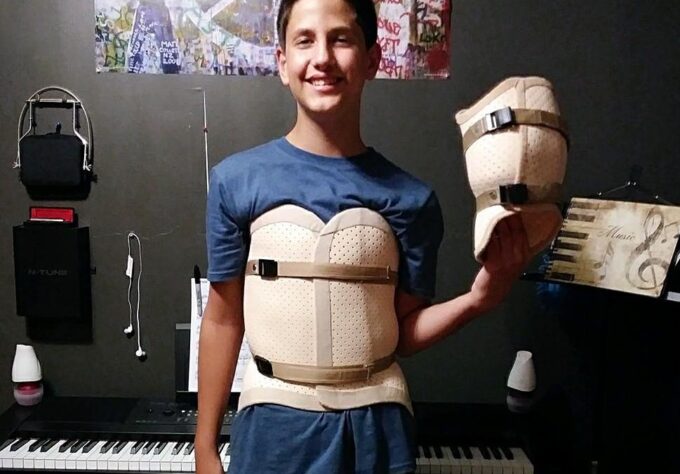
This year marked the fourth time that patients and families gathered to share stories, common concerns, and inspiration at our annual Patient and Parent Mentoring Event, hosted by the Nemours Spine and Scoliosis Center. More than 100 people gathered at Nemours/Alfred I. duPont Hospital for Children on a gorgeous spring day. As in years past, this event was open to families with adolescents who have idiopathic scoliosis, which is the most common form of the disease. More than 3% of the population has scoliosis, a condition that causes the spine to curve from side to side. For some, no treatment is necessary, just periodic monitoring of the curve by a healthcare provider. For others, treatment is required, which can include bracing to halt or slow down the progression of the curve, or surgery to correct the deformity. At the mentoring event this year, Dr. Suken Shah started things off by […]

Gestational Diabetes and Diet: How the Right Foods Can Help | Armando Fuentes, MD | Promise: Powered by Nemours Children's Health

Gestational Diabetes and Diet: How the Right Foods Can Help

You probably know someone who’s had gestational diabetes mellitus, or may have been diagnosed yourself. By any measure, it’s not rare. It’s estimated that about 200,000 cases of gestational diabetes—a condition that’s marked by glucose intolerance in pregnancy—occur every year. In fact, gestational diabetes may be present in up to 9.2% of all pregnancies. But the fact that gestational diabetes is pretty common doesn’t make it any easier to live with—especially when you’re dealing with all the other challenges of pregnancy. Gestational diabetes occurs when hormones from the placenta block the action of the insulin that the mother’s body produces. Insulin’s job is to help the body transform glucose in the bloodstream into useable energy. When the body can’t make or use insulin properly, glucose builds up in the blood, causing higher blood glucose levels that can be dangerous for a mother with diabetes and her baby. Women with gestational diabetes mellitus […]

Asthma Flare-Ups and Kids: What They Are, What You Can Do, Powered by Nemours Children's Health System

Asthma Flare-Up and Kids: What They Are, What You Can Do

A recent survey by Nemours Children’s Health System, the Delaware Survey of Children’s Health (DSCH), showed that parents of 88 percent of children with asthma were educated by health professionals on how to recognize early signs or symptoms of asthma episodes in their child. Understanding what an asthma flare-up is and how to recognize the early signs or symptoms are key steps in improving the health of your child. Increasing the percentage of parents who are taught how to recognize their child’s early signs or symptoms of an asthma flare-up (also called an asthma attack) can help reduce the number of asthma-related hospital visits and improve the overall health of their child. What is an Asthma Flare-Up? During an asthma flare-up, the breathing tubes (also called bronchial tubes) in the lungs constrict — like a straw being squeezed — which triggers wheezing, coughing and tightness in the chest. Some kids […]

Heart Murmurs in Kids: They’re Common and Usually Harmless, by Steven Ritz, MD | Promise, Powered by Nemours Children's Health System

Heart Murmurs in Kids: They’re Common and Usually Harmless

You might worry if you’re told your child has a heart murmur. But lots of kids are found to have heart murmurs at some point. And most won’t affect a child’s health at all. So What Is a Heart Murmur? The term “heart murmur” isn’t a diagnosis of an illness or disorder. The doctor might hear an extra sound in addition to the “lub-dub” we recognize as the heartbeat. A heart murmur is an abnormal sound (like a blowing or whooshing) that’s usually detected by a doctor who’s listening to the heart with a stethoscope during a routine examination. What’s an “Innocent” Heart Murmur? The most common type of heart murmur is an “innocent murmur” (also called a “benign” or “functional” murmur). This type of murmur is harmless. An innocent heart murmur is the sound of blood moving through a normal, healthy heart in a normal way. Just as you might hear air moving through an […]

Sudden cardiac arrest and teenage athletes | Steven Fishberger, MD | Promise: Powered by Nemours Children's Health System

Sudden Cardiac Arrest and Teenage Athletes: What’s the Risk?

Sudden cardiac arrest is nothing new, but it still gets plenty of attention when it affects a young athlete—usually because it’s so rare, unexpected and tragic. We’re all familiar with the stories of seemingly healthy teenagers collapsing on the field or court and succumbing to cardiac arrest. It’s estimated that between 6,000 and 8,000 young people experience sudden cardiac arrest (or SCA) each year, and only about one in 10 survive. The exact causes of SCA vary widely. Abnormalities in the heart or genetic conditions are often to blame, though there are times in which a definite cause is never found. In all cases, something causes the heart to unexpectedly beat out of control or stop beating altogether. Sudden cardiac arrest is so dangerous because it’s so hard to predict. But if the symptoms are recognized immediately, lives can be saved. Symptoms of SCA include: Collapse Lack of pulse No […]

Meet Emmy: An Atrial Septal Defect Success Story | Promise: Powered by Nemours Children's Health System

Meet Emmy: An Atrial Septal Defect Success Story

When Jill’s third child, Emmy, was born with a hole in her heart, Jill wasn’t too worried. Her two older sons also had the condition—called Atrial Septal Defect (ASD)—and theirs had cleared up over time. In children with ASD, blood recirculates inside the heart, and doesn’t reach the rest of the body as well as it should. Dr. Mary Mehta, Pediatric Cardiologist at Nemours Children’s Specialty Care, Pensacola, worked with the family to track Emmy’s condition. It didn’t improve, and it soon became clear that Emmy would need complex and invasive surgery to repair the hole in her heart. When Emmy was just three years old, the right side of her heart began to enlarge, presenting more risks: asthma-like symptoms and other coronary issues.  It was time to prepare for open heart surgery. Emmy’s family met with Dr. Peter Wearden, Cardiothoracic Surgeon at the Nemours Cardiac Center at Nemours Children’s Hospital […]

6 Common Pneumonia Questions Answered, by Kate Cronan, MD, Powered by Nemours Children's Health System

6 Common Pneumonia Questions Answered

Pneumonia is a very common illness in kids. In fact, an estimated 156 million cases of pneumonia are diagnosed worldwide each year — and that’s just in children younger than 5 years old, according to the World Health Organization (WHO). So here’s what you need to know about this infection that’s all too common around this time of year. 1. What is pneumonia, anyway? Simply put, pneumonia is an infection of the lungs. It causes fever, coughing and sometimes trouble breathing. The good news is that most kids with pneumonia can be treated at home, and they usually get better in 1 to 2 weeks. However, in some cases, babies and children with certain other medical problems can get sicker and may need to be admitted to a hospital while they get better. 2. Is there a pneumonia “season?” Your child may be more likely to get pneumonia after having a […]

Osgood-Schlatter Disease, Powered by Nemours Children's Health System

Kids’ Knee Pain: Is It Osgood-Schlatter Disease?

I remember when my son was 12 years old, he would wake up in the middle of the night crying and complaining of knee pain. He had started to run track in middle school, and he started to get a little bump just below his knee cap at the top of his shin bone. Our pediatrician called it “growing pains” and said it would go away. He recommended that he do some stretches and ice after track practice. Eventually it did resolve once track season was over, and he didn’t have any problems after that. What I found out later is that this wasn’t growing pains at all – it was a common sports injury known as “Osgood-Schlatter disease.” What is Osgood-Schlatter disease? Although it sounds scary because of the word “disease,” Osgood-Schlatter is one of the most common causes of knee pain in adolescents. It’s an overuse injury that […]

Sorting Out 7 Common Sports Injury Myths, by Alfred Atanda, Jr., MD, Powered by Nemours Children's Health System

Sorting Out 7 Common Sports Injury Myths

“No pain, no gain.” “Walk it off.” “He has a high tolerance for pain.” I’ve heard each one of these quotes and more during my many years as a pediatric orthopedic surgeon specializing in sports medicine. Many of them are actively detrimental to the health of your child, not just at that moment but when they grow into a professional athlete as well. As you already know sports injuries can be life-changing, that’s why many professional athletes take out long term disability insurance in case they are left permanently out of action. Would you be willing to put your child at risk of permanent injury because of a few false preconceived notions you can easily avoid? The answer should always be “no”. How many sports injury myths do you believe to be true? Here’s a list of the most popular things I hear regarding preventing and dealing with sports injuries, […]

Page 29 of 31

Page 29 of 31

Page 29 of 31